Close

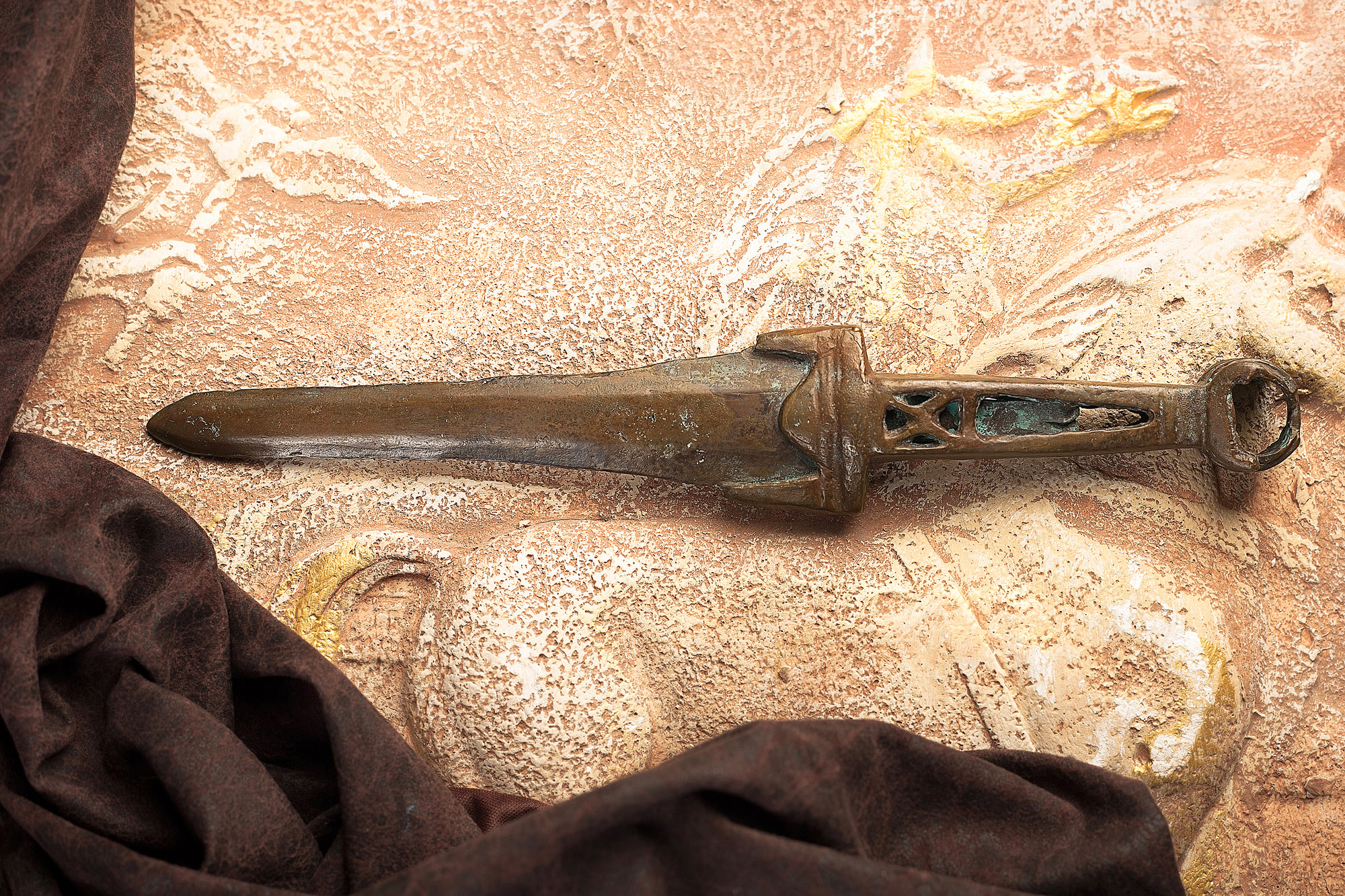
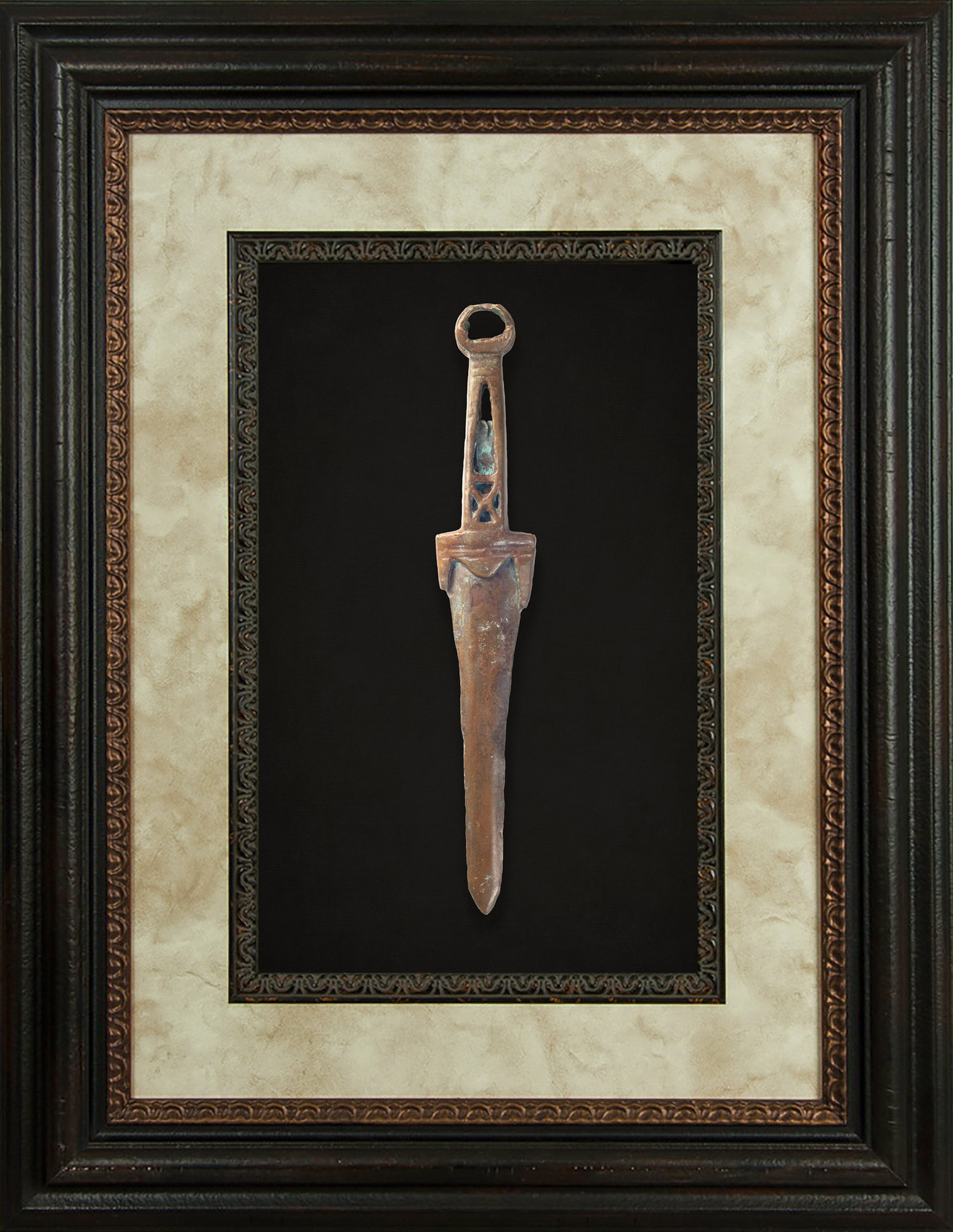
Dagger TD001

It is a copy of the XIV-XIII cent. BC artifact
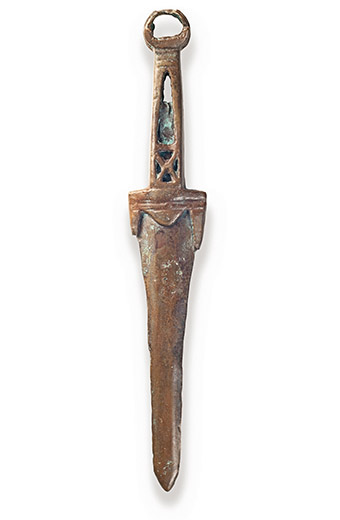
Item – dagger,
Material – bronze,
Method of manufacturing – moulding, inlay
Dimensions:
Overall length of dagger – 24.7 cm
Blade length – 14.6 cm
Blade width – 1.5-3 cm
Ricasso height – 2.8 cm
Ricasso width – 4 cm
Hilt length – 8 cm
Hilt width -. 1.2-1.6 cm
Knob diameter -. 2.4 cm
Weight – 220 g.
Type – Third Subtype – composite dagger

A dagger is not a huge but an effective weapon. It was originally used by shepherds and cattle-breeders. Since the end of the IV millennium BC, the period when Kura-Araxes culture reigned in the Armenian highlands, tanged daggers, made of arsenical bronze, were widely spread over the present territory of Armenia. Later on the daggers made of tin bronze appear. Not only in the era of the middle and late Bronze Age were the bronze daggers common in the Middle East and the Caucasus, but in the early Iron Age as well, before the VIII cent. BC inclusive.
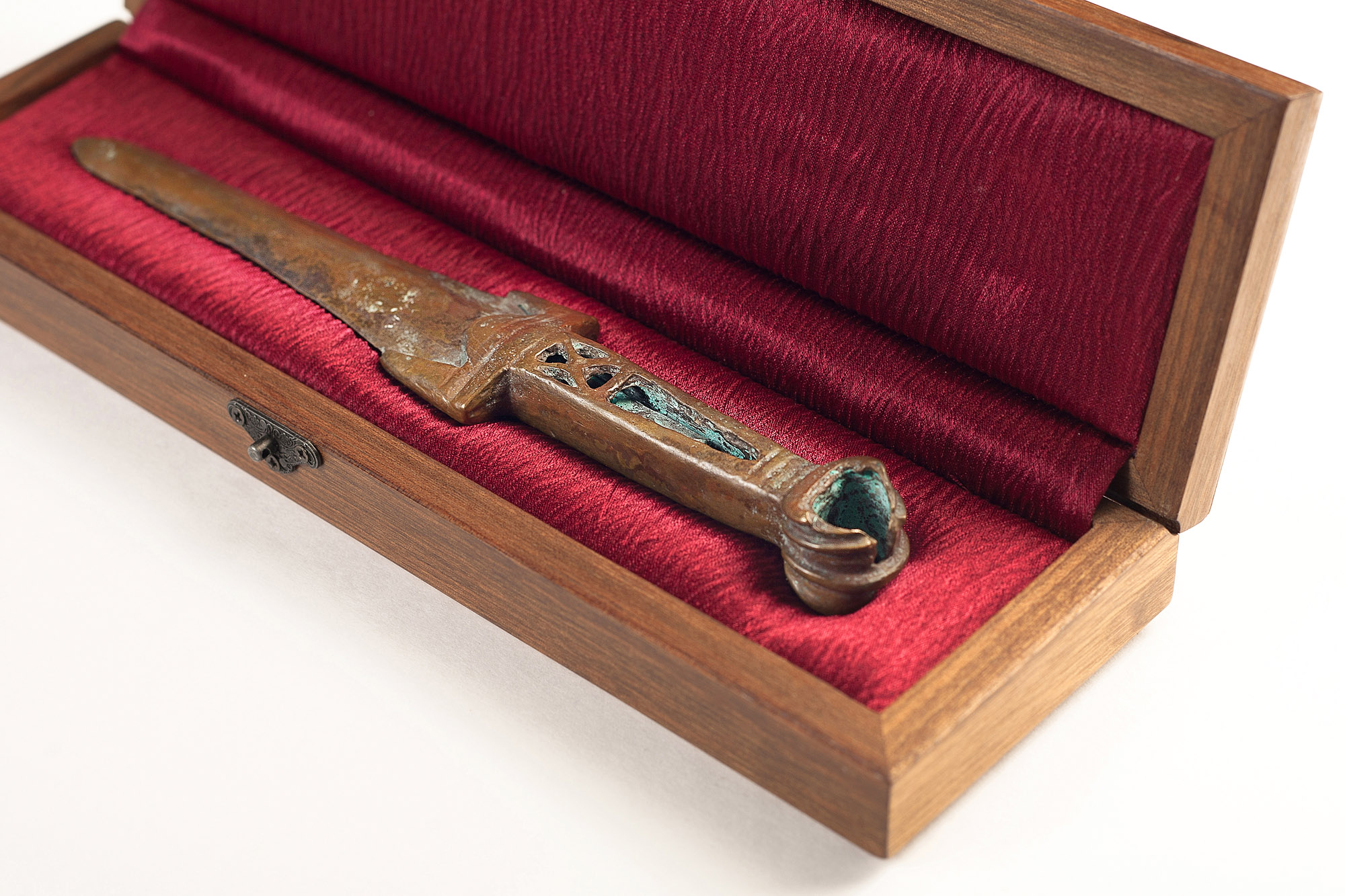
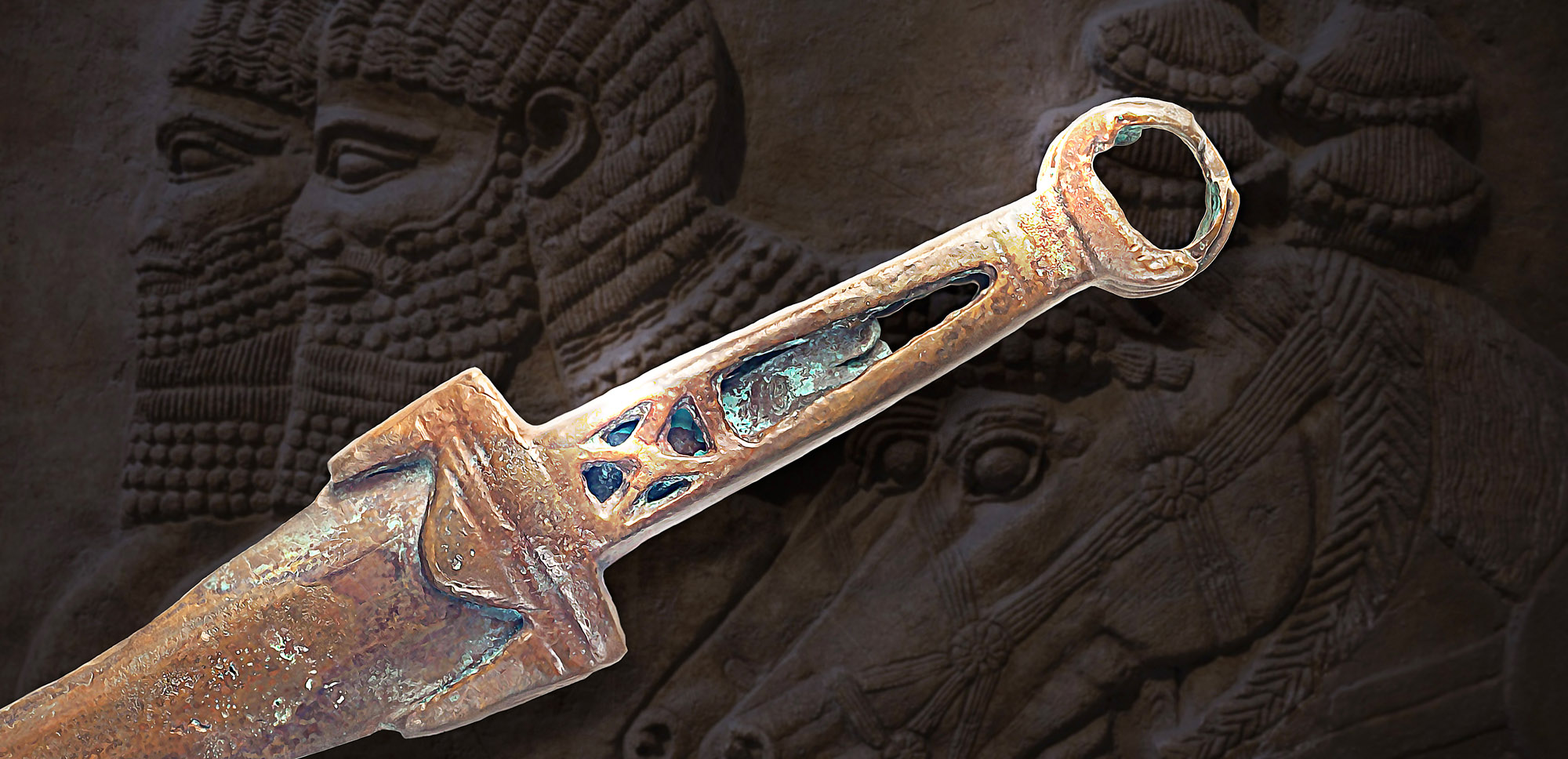
Bronze daggers found in Armenia are divided into seven types and many subtypes. Dagger TD001 belongs to a composite type, which in the literature is referred to as the third type. However, it differs from them by its hilt, as it has a rectangular shape. Thus, it resembles the daggers of the second type, called the “dagger with flanged hilt.”

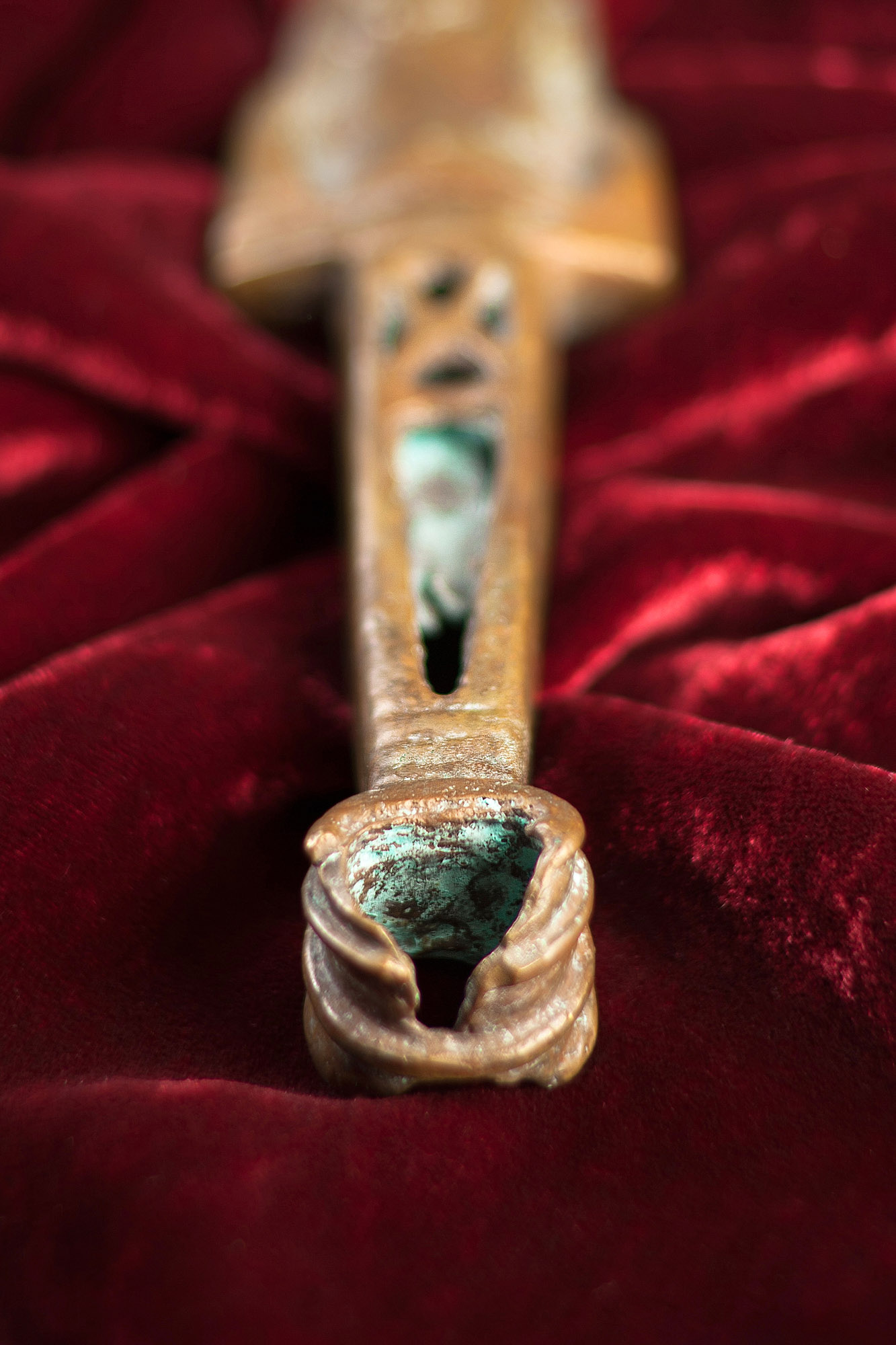
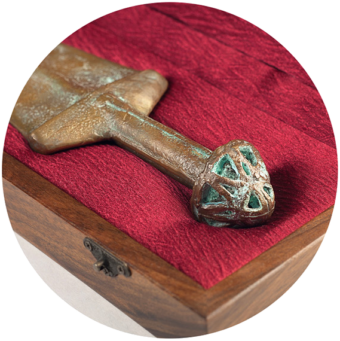
The hilt of the dagger TD001 is equipped with a rounded, fan-shaped, hollow knob. On the top, under the hilt on the front and the back sides there are three parallel relief lines, and in the middle there is a large elongated triangular cutout through which the grip of the blade can be seen. The lower part of the hilt is delicate. This decoration consists of four small triangles combined in the form of the Maltese cross. The blade is elongated and triangular. The dagger probably represents a transitional form of daggers with flanged hilt to a composite dagger.

Due to this fact it can be dated to the earlier time of composite daggers, i.e. XIV-XIII cent. BC. This dagger seems to be a rare copy, an analogue to which is hard to find. During this period the daggers apparently showed the social position of their bearer, the warrior, being a part of the traditional costume.

During the early Iron Age the modern territory of Armenia was called Etiuni and, when the soldiers of that country joined the army of The Van Kingdom, the Urartu kings were calling them “huradine”. According to the information obtained from the archaeological excavations of Artik burial places, the warrior from Etiuni, in addition to a dagger, could also carry a spear, an ax, a bow and arrows on the battlefield.

In the XIV-XIII cent. BC with the help of these weapons the people of Etiuni fought against the armies of Mitanni and Hittite, and in VII-VI cent. BC against the Cimmerians, the Scythians, and the Medes.

PhD in History, Prof S.G. Hamayakyan

hand made


Every item is produced manually. After casting the craftsmen do their best to make the copy look like the original. We do not only want to convey every notch and curve to the connoisseurs of the antiques, but also to reveal the spirit of that mysterious and legendary epoch.

The original packaging box made of natural wood with company logo is also finished off manually and serves as a reliable storage for our products.

limited edition

Every item of «Torgom-S» Company has its identification number, which is engraved on the handle and declared in the certificate. The letters and numbers of the personal identification number specify the firm-manufacturer, whether the original of the model is a swоrd or a dagger, and the order number of the item in its model range, indicating its classification in the Company’s Catalogue.

For instance, TD006 / 112 means – T – «Torgom-S» Company, D – (dagger), 006 – (№6 in the daggers’ model range) and 112 is (personal identification number).

Depending on the product the maximum number of copies of each model will vary from 200 to 2000 units, which is initially stated in the certificate. After producing the last unit the forms will have been destroyed and the Company guarantees the limitation on this very unit.

ORDER AND DELIVERY

You can order either by phone or e-mail. Our managers will contact you for the details of the delivery and payment. The products are also available at pick up points, Yerevan, Armenia.

Order