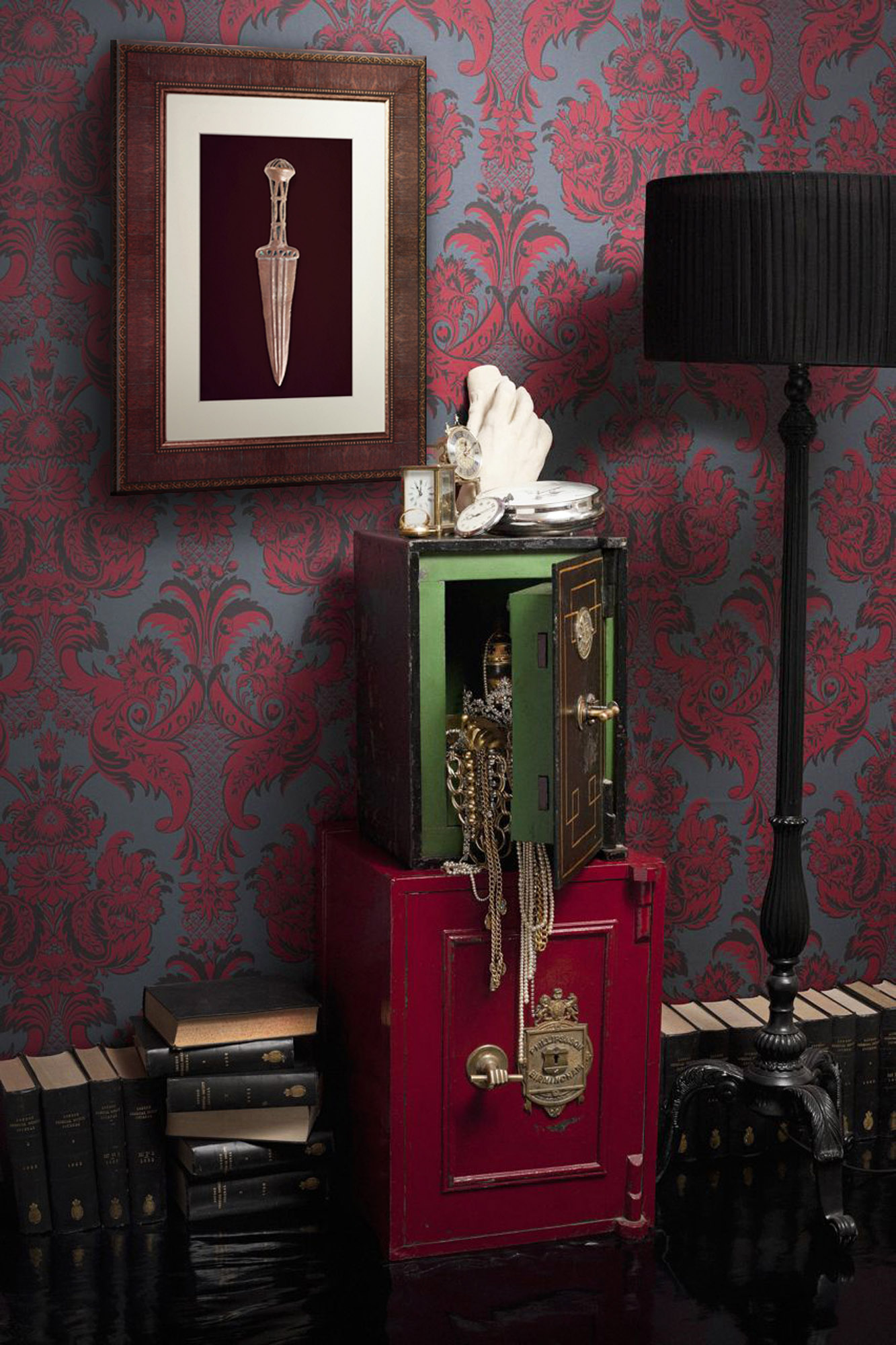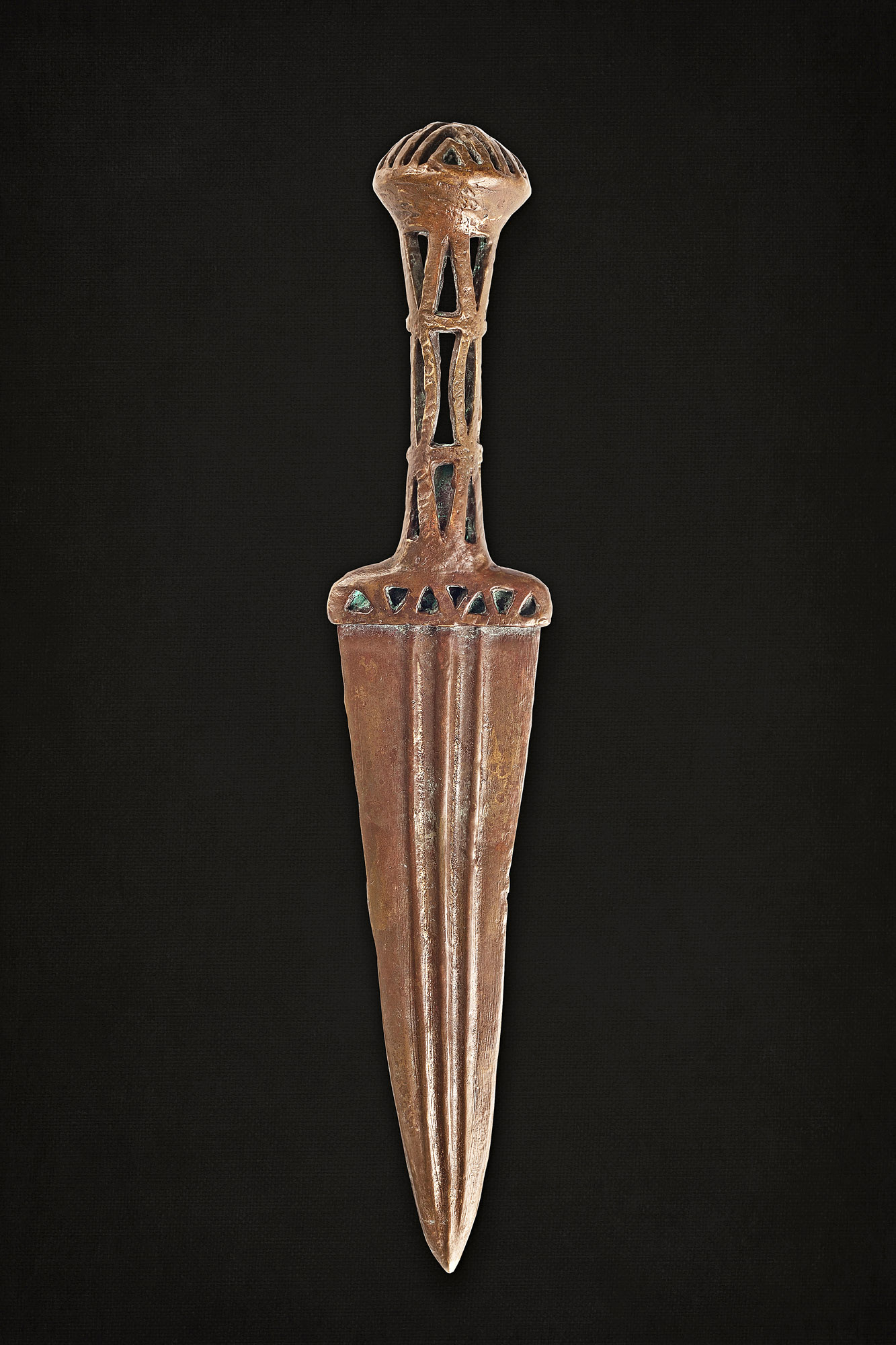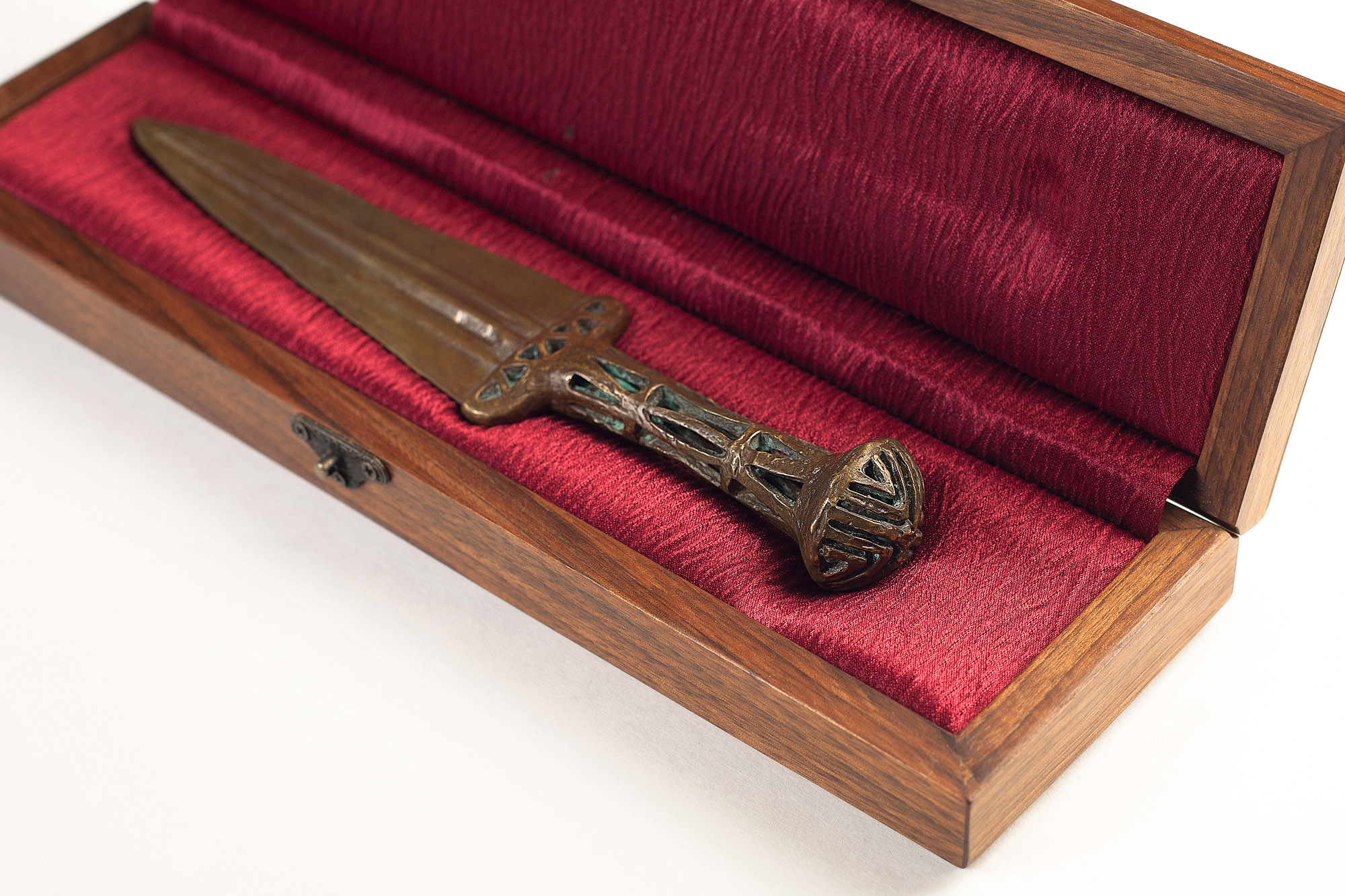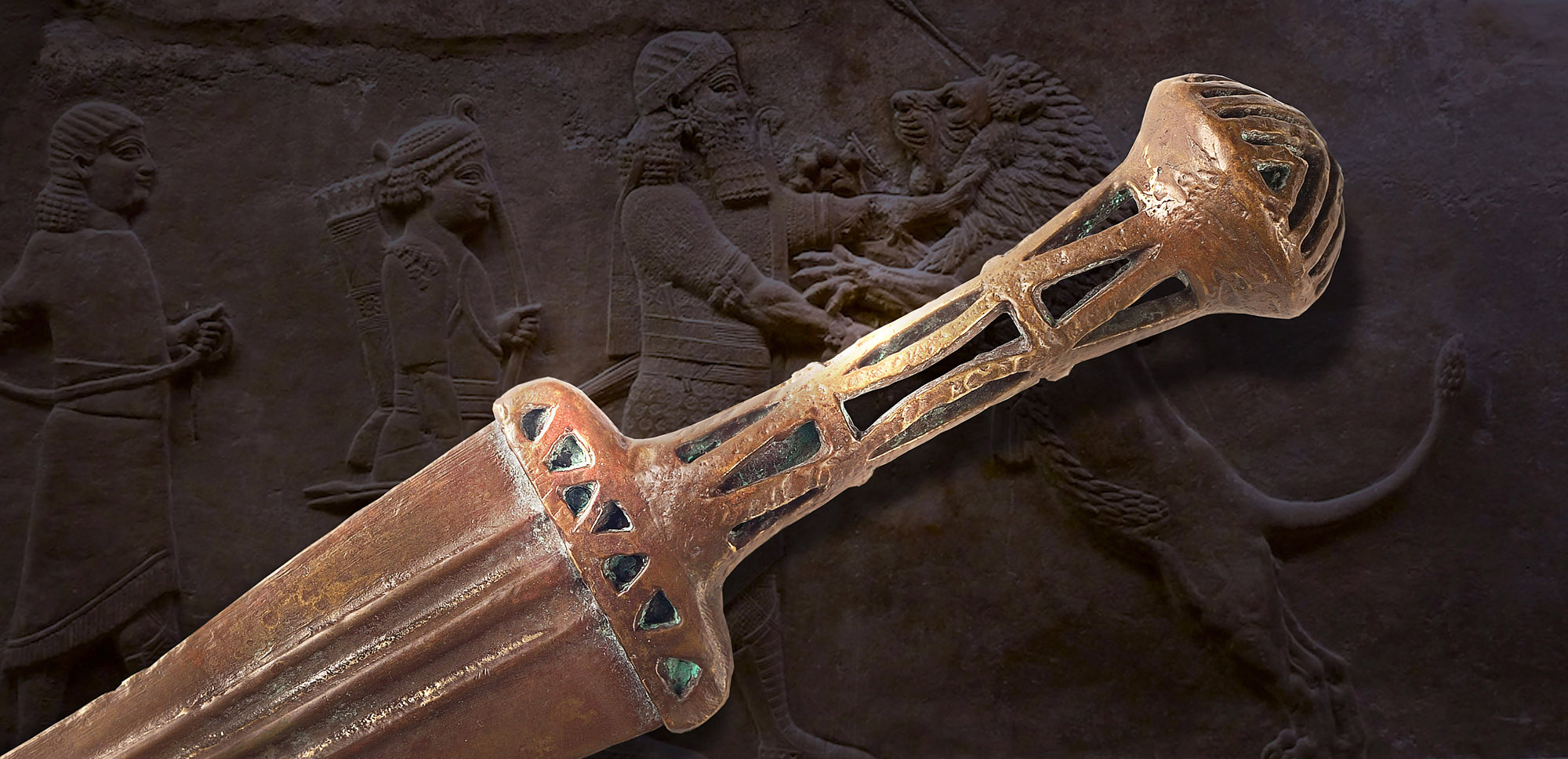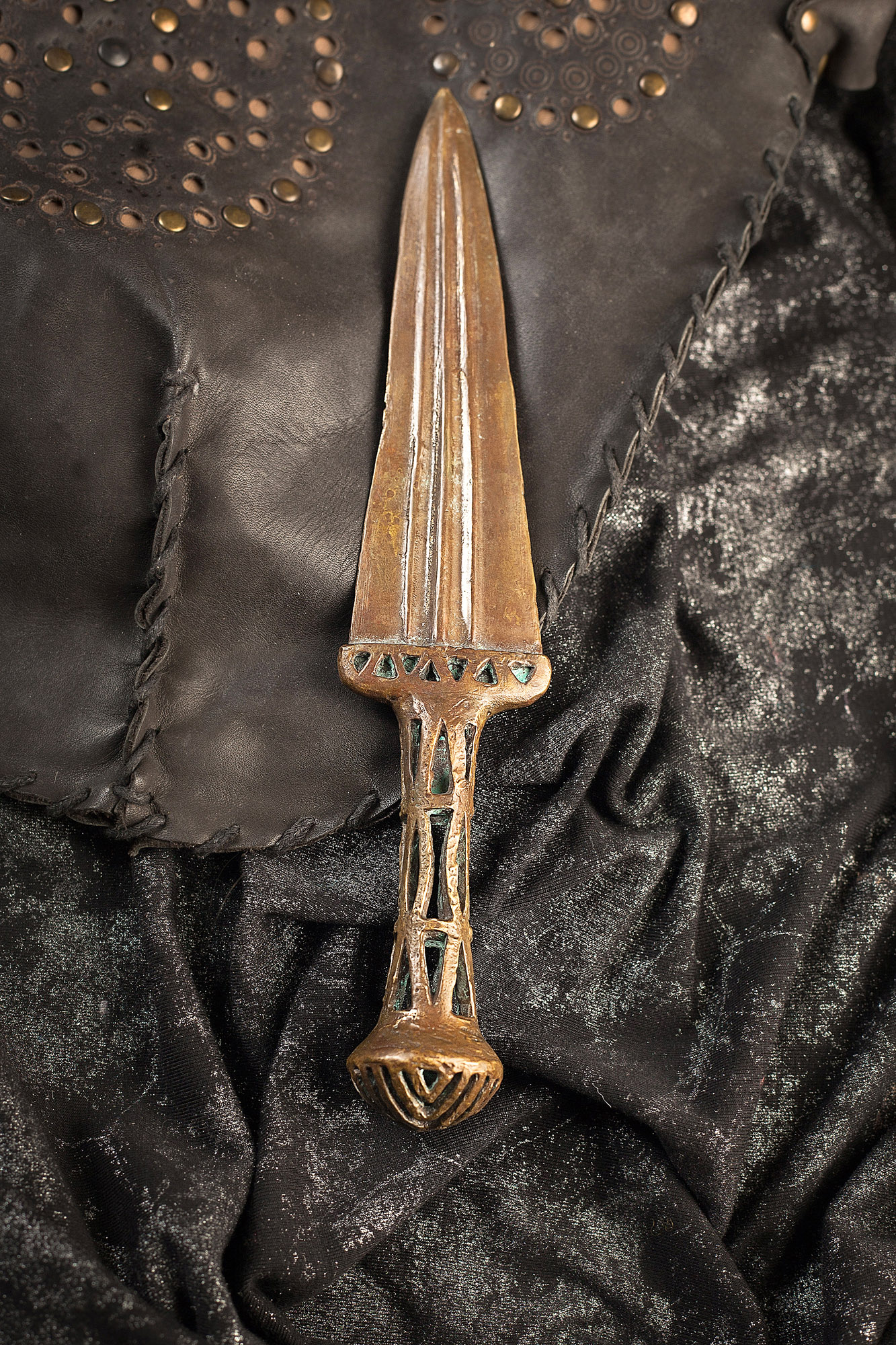
It is a copy of the XIV-XI cent. BC artifact
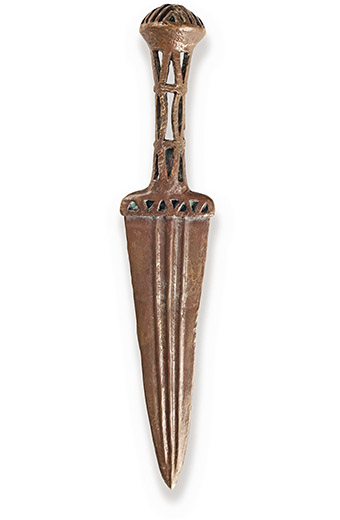
Item – dagger
Material – bronze
Method of manufacturing – casting, inlay
Dimensions:
Overall length of the dagger – 23.8cm
Blade length – 13.3cm
Width of the base of the blade – 4cm
Ricasso height – 1cm
Ricasso width – 4.4cm
Hilt length – 6.7cm
Hilt diameter – 1.4-1.8cm
Knob height 1.8cm
Knob diameter – 3.1cm
Weight – 160 g.
Type – third
Subtype – composite dagger
A dagger is not a huge but an effective weapon. It was originally used by shepherds and cattle-breeders. Since the end of the IV millennium BC, the period when Kura-Araxes culture reigned in the Armenian highlands, tanged daggers, made of arsenical bronze, were widely spread over the present territory of Armenia. Later on the daggers made of tin bronze appear. Not only in the era of the middle and late Bronze Age were the bronze daggers common in the Middle East and the Caucasus, but in the early Iron Age as well, before the VIII cent. BC inclusive.
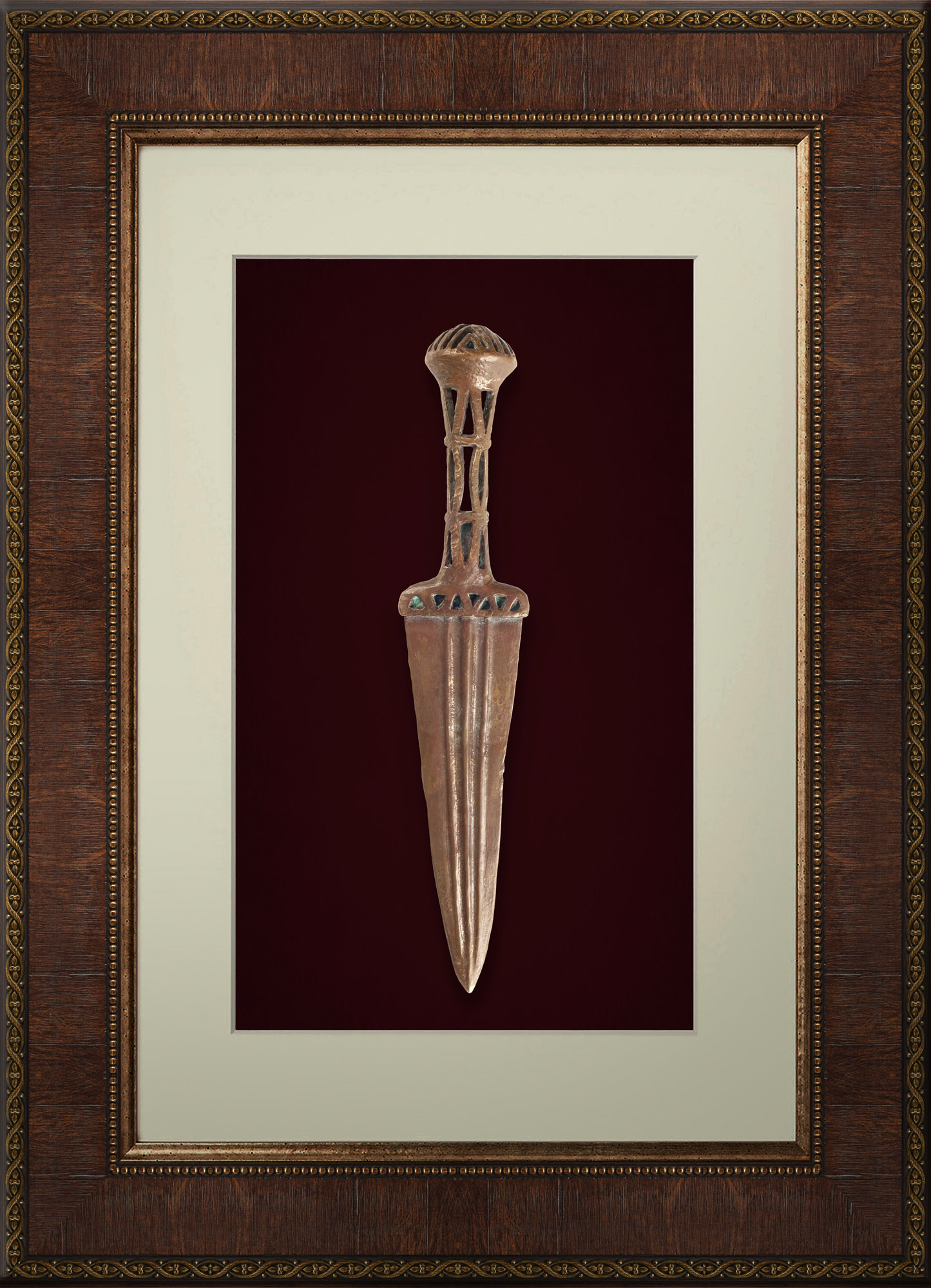
Bronze daggers found in Armenia are divided into seven types and many subtypes. Dagger TD005 belongs to the third type. In Armenia the bronze daggers of this type with a cylindrical, delicate hilt appear in the late Bronze Age since the XIV-XIII cent. BC, they exist throughout the era and continue to exist in the beginning of the Early Iron Age, up to the XII-XI cent. BC.
The first copies of this type of daggers have been found in the basin of Lake Sevan, in Lchashen. They are divided into several types. This dagger belongs to the subtype of composite daggers. It consists of a separately molded hilt and an elongated wide wedge-shaped blade, with three straight edges in the middle. The blade ends with tracery quillion, of which a hollow trunk of the hilt, crowned by a hemispherical pommel, rises. On both sides of the ricasso there are seven isosceles triangles depicted, four of which are located with the base towards the blade, and three – with the base towards the hilt.
From the blade side there are 8 acute triangles carved on the hilt, 4 of which are looking towards the base of the blade, and the remaining 4 – in the direction of the knob. 8 triangles are depicted the same way in that part of the hilt which adjoins the knob. 8 geometrical patterns are curved in the middle of the hilt. Similar openwork hilts were, perhaps, inlaid with colorful wooden segments, and the hollow of the hilt was being filled with bitumen.
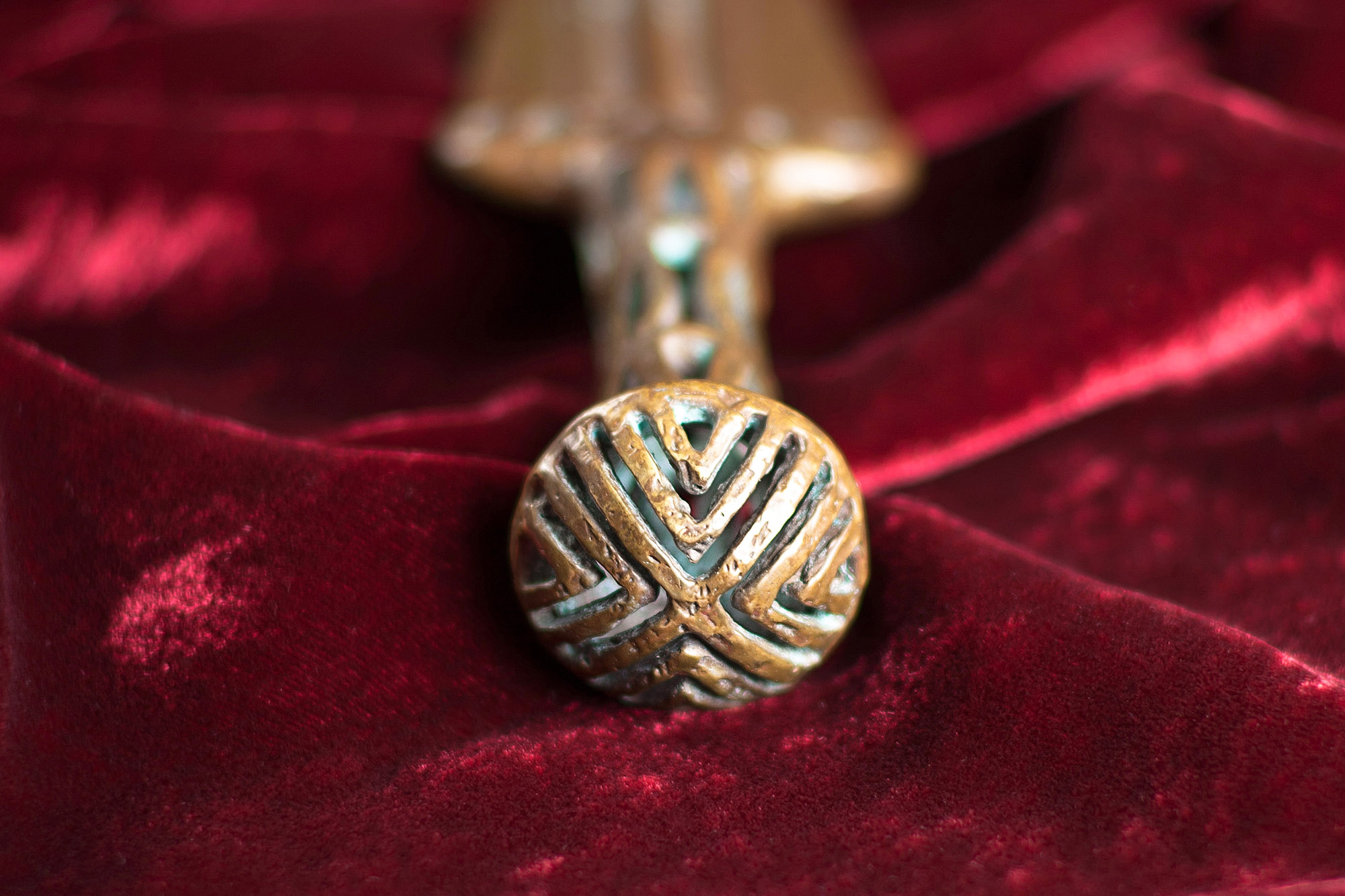
The knob is decorated with a large cross, in four segments of which there are three triangles embedded in each other. The tops of these triangles are facing the cross.
It can be often observed within this type of daggers. Obviously, there was a cult of the cross in the culture where the dagger was created. The daggers showed the social position of their owner, the warrior, during that period and obviously were a part of the traditional costume.
The daggers of this type were produced in Armenia and sometimes exported to the North Caucasus and to the north-east of Iran.
PhD in History, Prof S.G. Hamayakyan
Every item is produced manually. After casting the craftsmen do their best to make the copy look like the original. We do not only want to convey every notch and curve to the connoisseurs of the antiques, but also to reveal the spirit of that mysterious and legendary epoch.
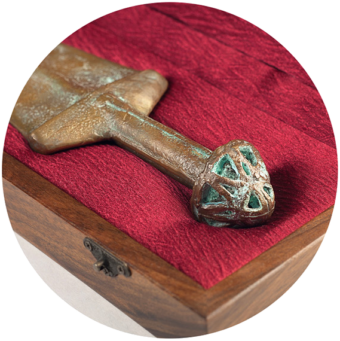
The original packaging box made of natural wood with company logo is also finished off manually and serves as a reliable storage for our products.
Every item of «Torgom-S» Company has its identification number, which is engraved on the handle and declared in the certificate. The letters and numbers of the personal identification number specify the firm-manufacturer, whether the original of the model is a swоrd or a dagger, and the order number of the item in its model range, indicating its classification in the Company’s Catalogue.
For instance, TD006 / 112 means – T – «Torgom-S» Company, D – (dagger), 006 – (№6 in the daggers’ model range) and 112 is (personal identification number).
Depending on the product the maximum number of copies of each model will vary from 200 to 2000 units, which is initially stated in the certificate. After producing the last unit the forms will have been destroyed and the Company guarantees the limitation on this very unit.
You can order either by phone or e-mail. Our managers will contact you for the details of the delivery and payment. The products are also available at pick up points, Yerevan, Armenia.
«Torgom-S» Company, Yerevan, The Republic of Armenia
Tel: +374 93 41-41-40
E-mail: torgom.am@gmail.com
Torgom 2017. ©