Bronze swords found in Armenia are divided into four types (according to S.A. Yesayan):
1. Swords with a Y-shaped (or fork-shaped) hilt,
2. Solid cast swords with a framework hilt (West-Asian type),
3. Solid cast swords with a tubular hilt, and
4. A separate group of special type weapons consisting of rapiers, versions of which are known in the Crete-Mycenaean world.
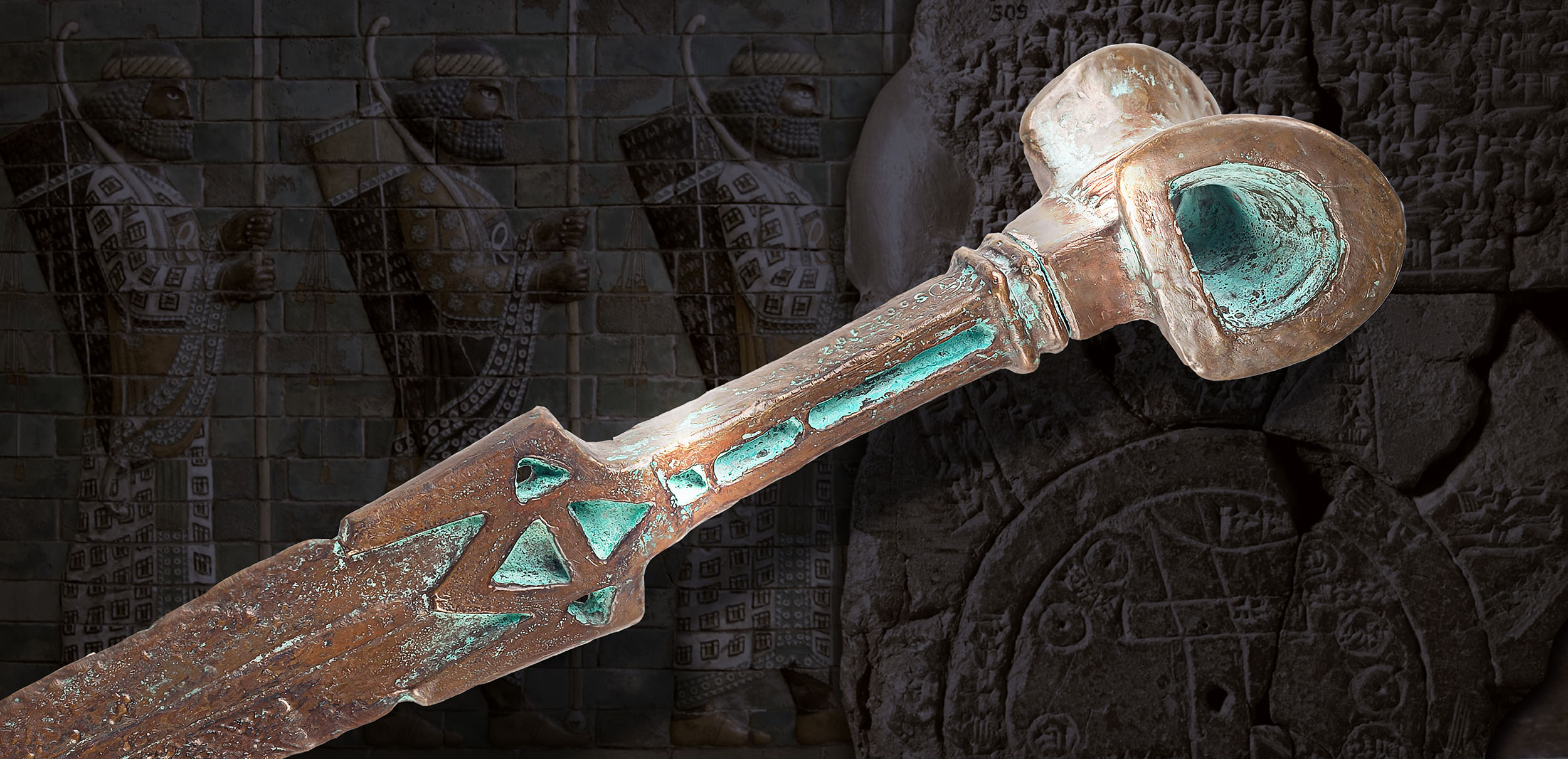
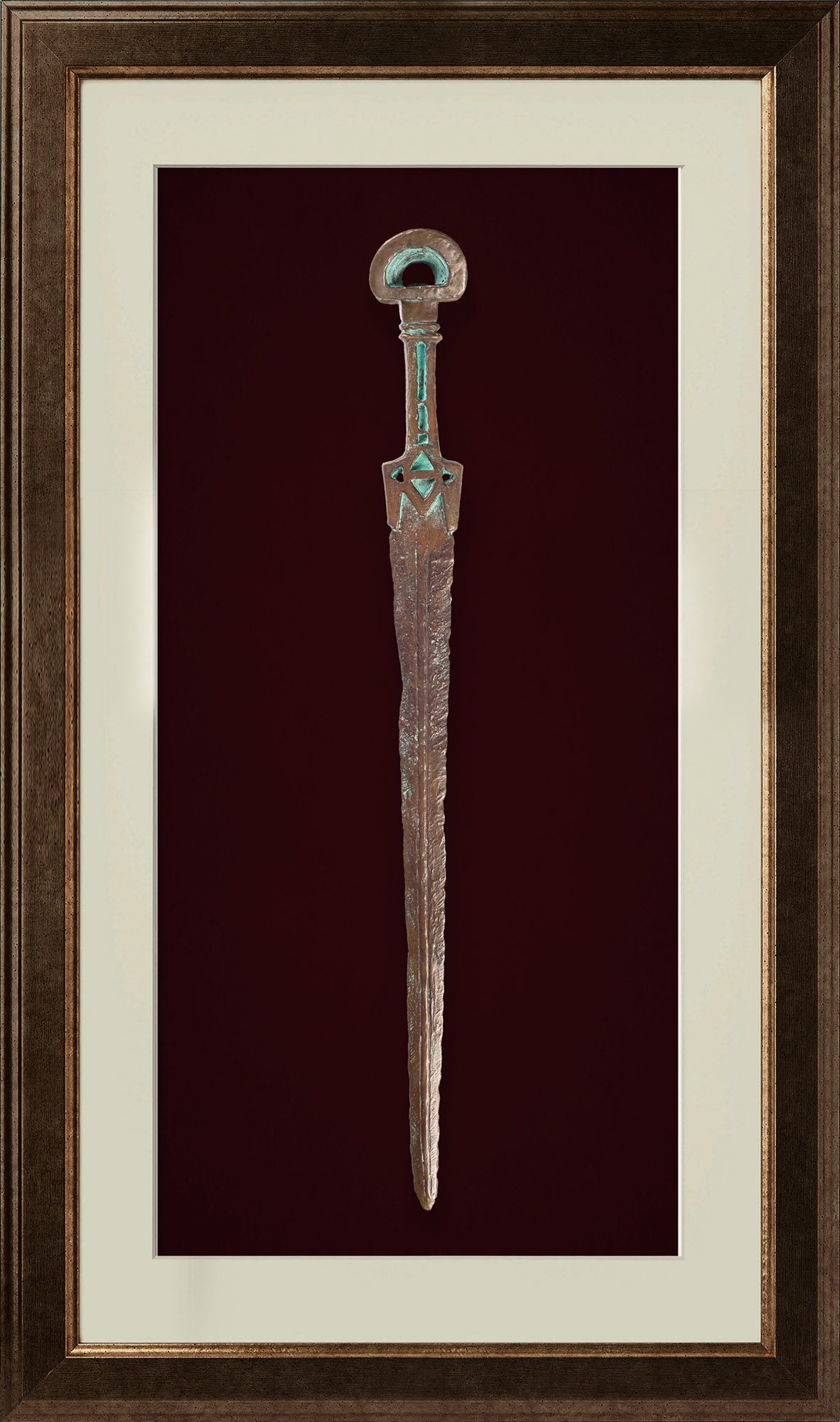
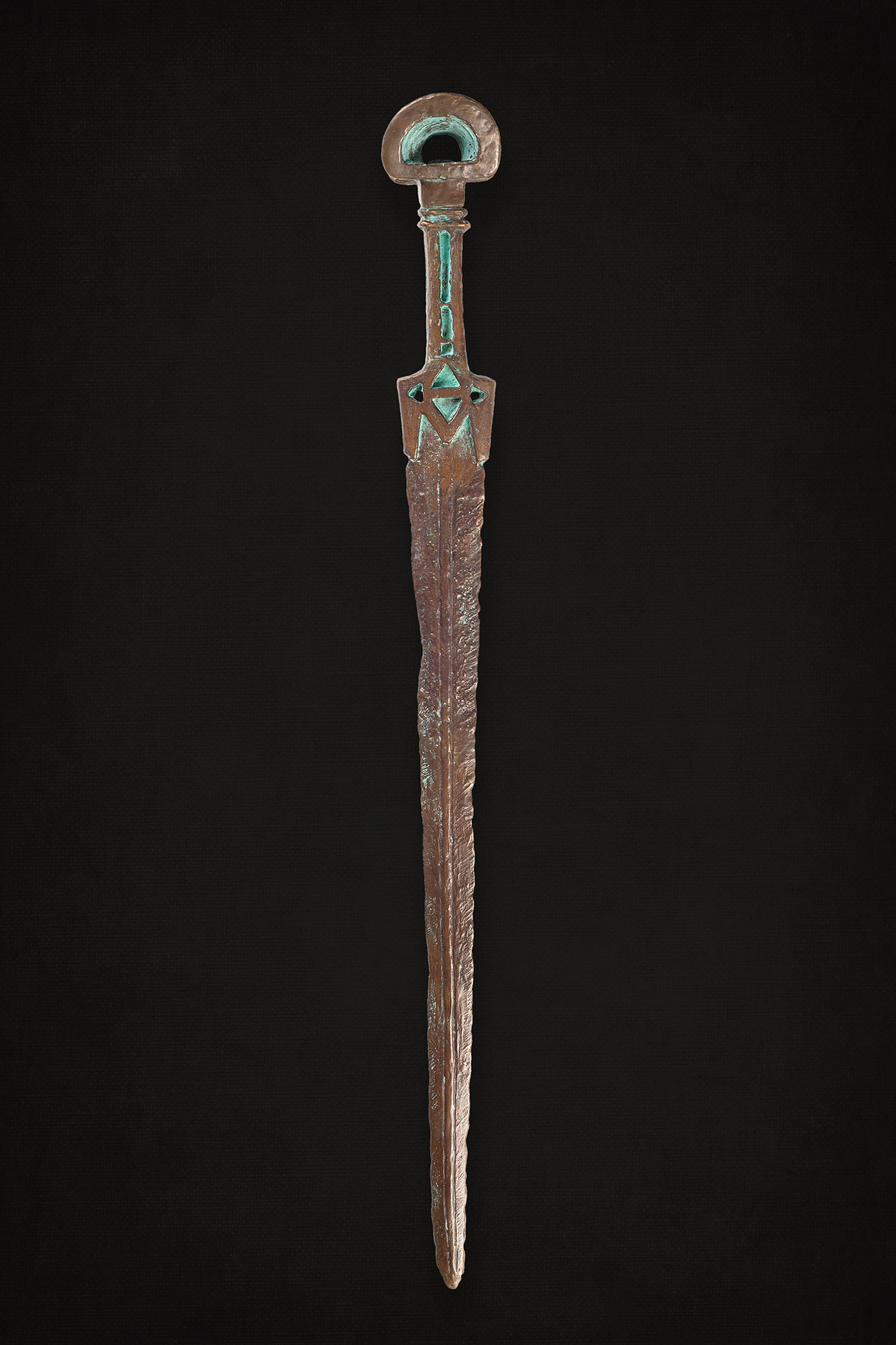
The original of this sword was found in the neighbourhood of Vardenis, Gegharkunik marz (region) in the Republic of Armenia.
According to the classification proposed by S.A. Yesayan, it belongs to the first type – ‘swords with a Y-shaped hilt.’ According to the classification suggested by A.S. Piliposyan, this object can be attributed to the thirteenth version of the second subtype of swords and daggers – ‘swords and daggers with a saddle-shaped pommel’ (while according to the classification by M.N. Pogrebova, it falls within ‘daggers and swords with a double-flared grip’).
This is a double-edged sword with a central ridge.
The sword was used in battles – the blade has numerous dents from blows. The blade is narrow, thin, elegant, and durable.
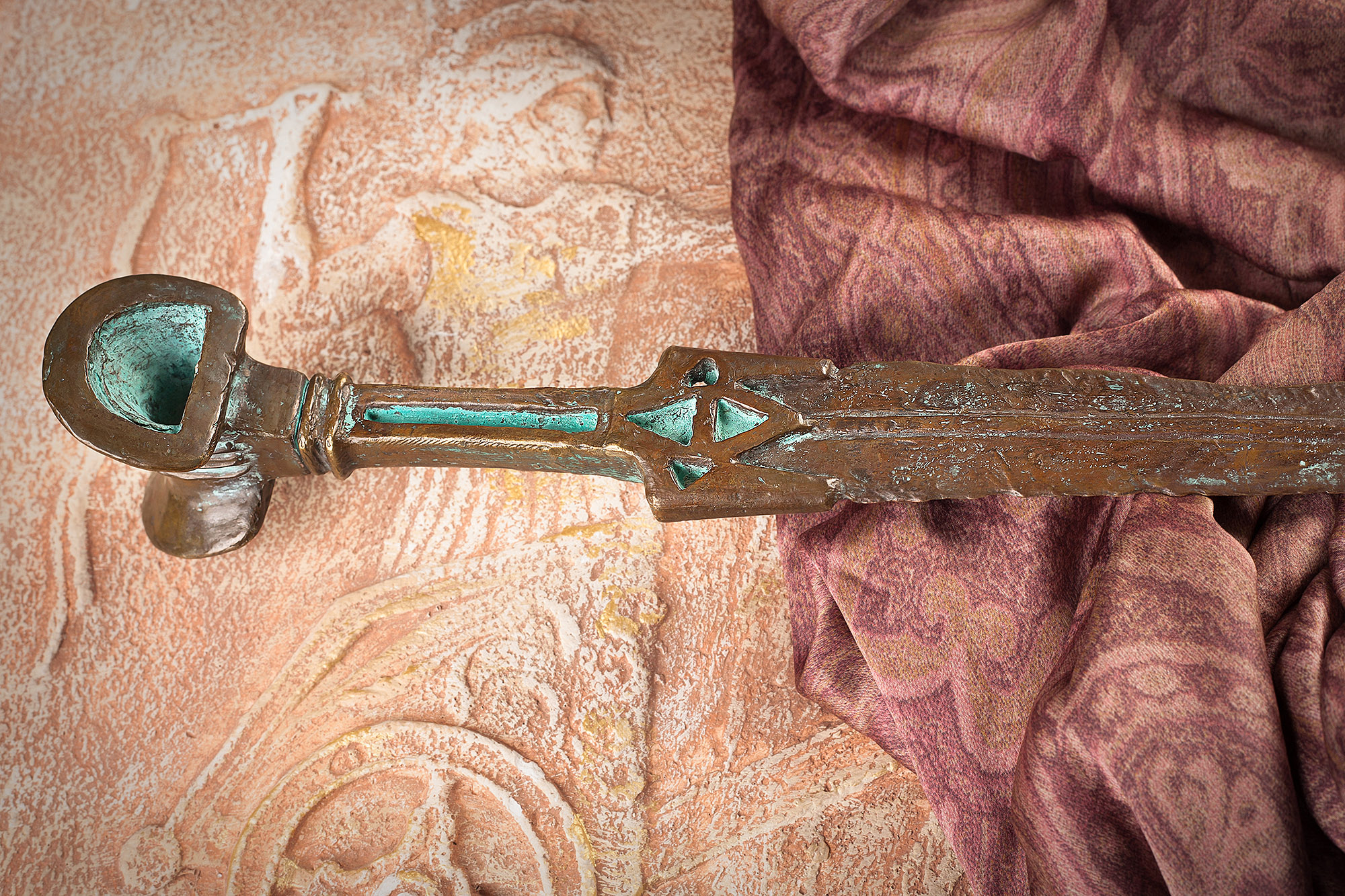
The ricasso is richly decorated with geometric figures. On its lower part there is a figure resembling the Latin letter “M”. In the middle of the ricasso there are two isosceles triangles, one with the vertex up, the other with the vertex down. There are two open-worked triangles, one to the left and one to the right [above the “M”-styled figure].
The hilt has a rectangular shape and, unlike the ricasso, is ornamented with chiselled rectangular figures: thus, on one side, there is a rectangular shape recess in the middle, and on the other side, there are three such recesses: one is large, another is of a middle size and the third one is small and has a square shape.
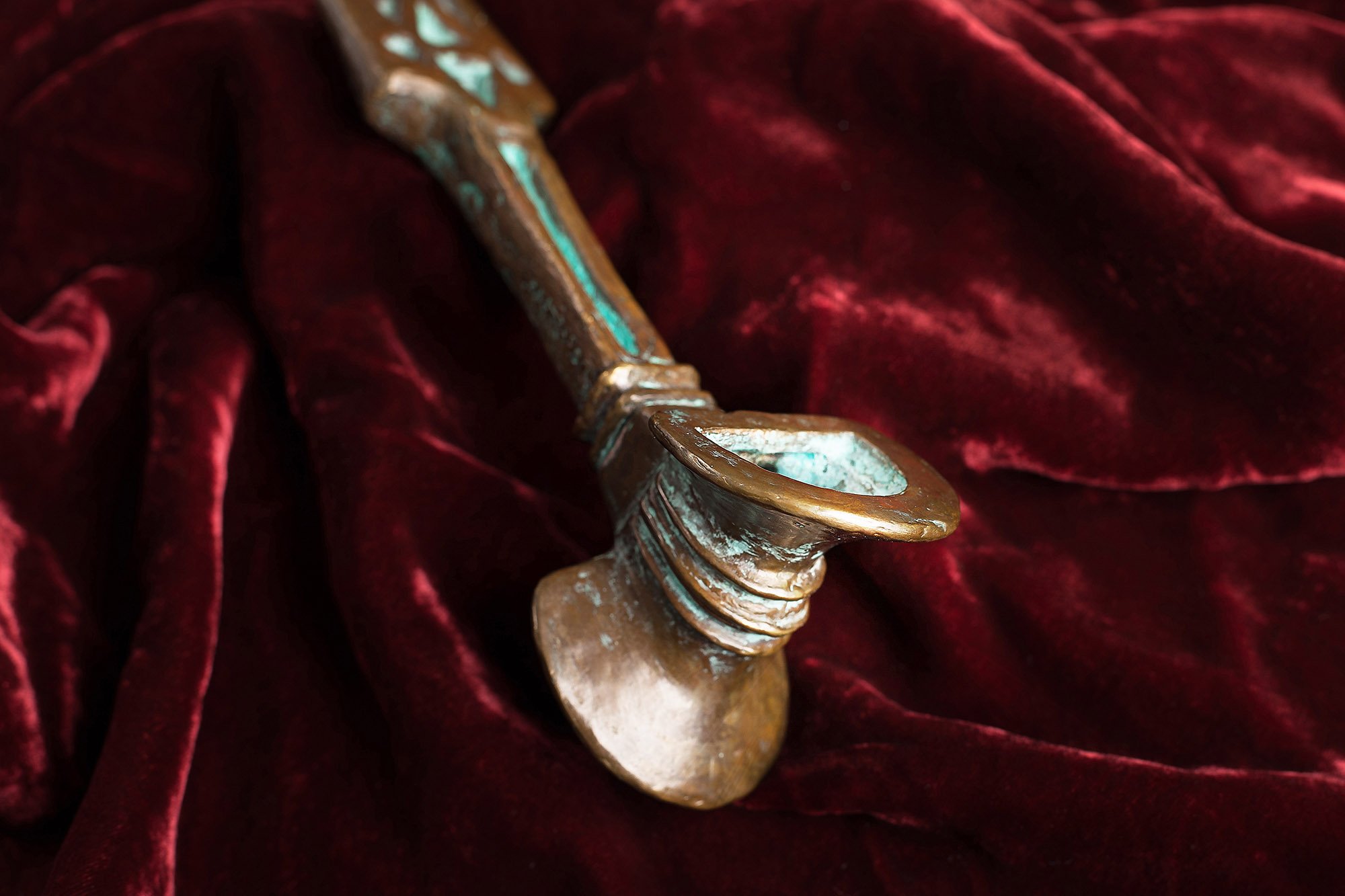
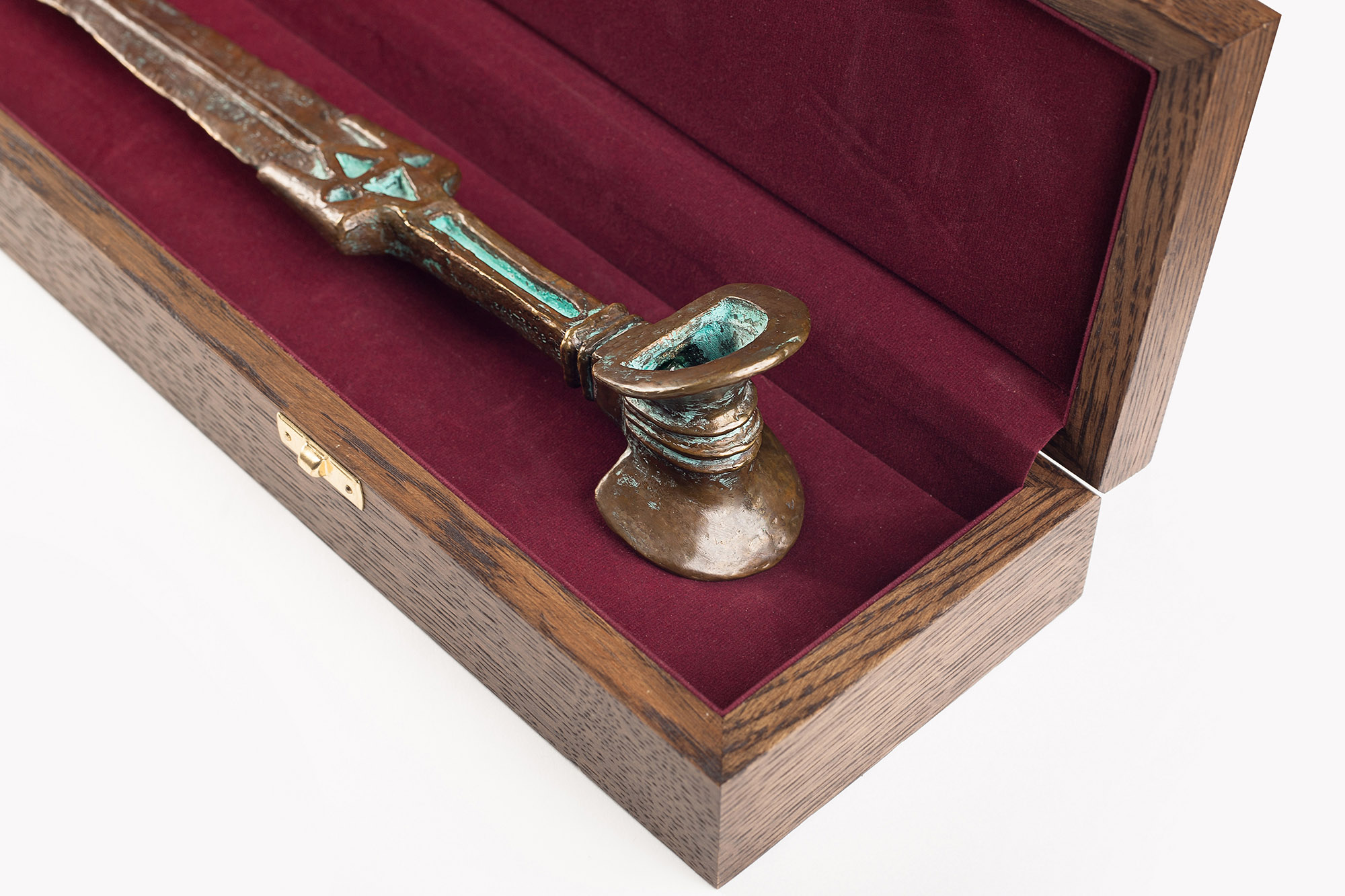
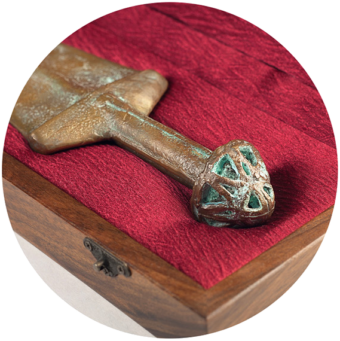
These recesses are assumed to have held wooden and bone plates. At the top, the hilt ends with two raised, cord-like “belts” going around both sides. The pommel is massive and saddle-shaped. It was cast separately from the blade and hilt. The “saddle” has large hemispherical hollow “ears” (4×4.5 cm) and an ornamented middle part.
A peculiar feature of this type of daggers is that the saddle-shaped pommel is attached perpendicularly to the blade so that the “ears” face the flat surfaces of the blade, not the cutting edges, as one would expect. Thus, such a sword can only be placed onto the horizontal plane with a cutting edge down. This is a much safer position, which does not let the sword break easily.
Swords with a Y-shaped hilt began appearing in Armenia in the 14th cent. BC. The most ancient specimens were found in the course of excavations at Lchashen. Similar swords, equipped with an iron blade, however, existed until the 7th cent. BC.
This sword, though, has the peculiar saddle-shaped pommel. Swords and daggers with a similar pommel are known throughout the Middle East. They are also depicted in Assyrian reliefs. Swords with a saddle-shaped pommel were found in Luristan and North-West Iran.
Daggers of a similar type were found during excavations at various monuments in Armenia (as well as in enclosed compounds), and the earliest objects date back to the 12th-10th cent. BC.
However, I have no knowledge of any swords with a saddle-shaped pommel found in the [present-day] territory of the Republic of Armenia, and in this respect, this item is exceptional. It has been categorized as a sword, based on the length of the blade (which is more than 40 cm long).
Holding on to the assumption that swords are an altered form of daggers, it is possible to date this sword to a later period than when daggers of this type existed, i.e. to the 10th-9th cent. BC. It is also necessary to take into account the fact that daggers with a saddle-shaped pommel – but with an iron blade – are known as well and they date back to the 8th-7th cent. BC.
The territory of the present-day Republic of Armenia was part of a confederation called Etiuni in the 9th-7th cent. BC. The region of Vardenis at that time was the chiefdom, called Arkukini. This kind of sword unusual for Armenia could belong to the heretogh, i.e. the knight.
In the 8th cent. BC the soldiers of Etiuni began to serve in the Urartian army and through joint efforts fought against the Assyrians, Cimmerians, Scythians and later against the Babylonians and Medes.
PhD in History, Prof S.G. Hamayakyan